- Vivências – Learning Through Shared Experience
- Working with Trees – Patrick Barmet
- Living Soil – Ramon Grendene
- Manifesto of the Second Soil Assembly – Manaus
- Decolonization of the Plate – Now!
- Displacement of Sustainable Agriculture
- Art and Soil
- Agroforesty Systems
- Live of Soil
- From Body to Land
- Participatory Agriculture
- PANC Amazon Wild Plants
- Fermenting and Transforming
- Deforestation
- The natural landscape
- With the fields
- Handicrafts from farmers
Practical environmental education through planting, building, cooking, experimenting and learning together. Brazil. Since 2021
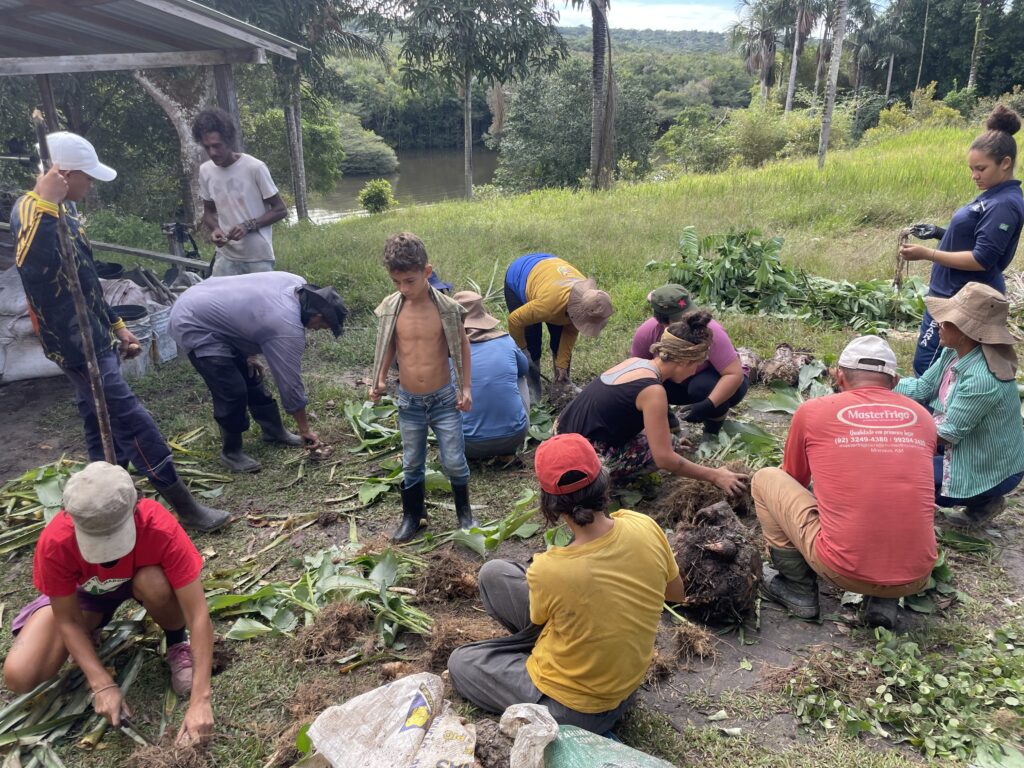
The landscape as a learning environment – knowledge grows through shared experience.
How do we learn when the forest itself becomes the classroom? When we observe plants, examine soils, grow food, cook together and build with natural materials?
Since 2021, Tera Kuno has been developing an open learning environment through Arte & Escola na Floresta in the Brazilian Amazon. Here local and traditional ways of knowing meet art, science, environmental education and agroecological practice.
Since 2024, the programme has been recognised through the Sala Verde initiative of Brazil’s Ministry of the Environment (MMA).
Learning through experience and dialogue
Our educational approach draws on Paulo Freire’s dialogical pedagogy and the idea of situated learning: knowledge does not arise separately from people’s living conditions, but through exchange with their environment, their experiences and their social worlds.
The landscape is not simply an object of study but a living learning environment. Children, adults, farmers, artists, teachers and researchers contribute different experiences. Observation, questions, experimentation and collective action form the basis of learning.
Vivências
A central format of our educational work is the Vivências: multi-day collective learning experiences that bring together practical action, sensory perception and dialogue. They take place both within Arte & Escola na Floresta and in our international encounters.
More about our learning approach: Vivências – Learning through Shared Experience →
Putting knowledge into practice
Our workshops explore agroforestry, PANC (non-conventional edible plants), soil fertility, composting, water treatment, fermentation and ecological building techniques.
Artistic practices such as drawing, theatre, music, movement and collective storytelling offer further ways of engaging with the landscape and its living relationships.
Activities are developed together with local communities, public schools and universities, especially UEA, UFAM and IFAM.
Results to date
- Since 2021, ongoing development of the educational programme Arte & Escola na Floresta.
- 2023: 37 participatory learning experiences
- 2024: recognition as a Sala Verde by Brazil’s Ministry of the Environment. 18 workshops · 28 Vivências · 727 participations
- 2025: 30 workshops · 21 Vivências · 1,773 participations
- Development and testing of educational activities relating to agroforestry, food, water, soil, ecological construction and artistic forest education.
- Development and strengthening of collaborations with universities, teachers and local knowledge holders.
Looking ahead
The experiences of Arte & Escola na Floresta provide an essential foundation for the Escola da Floresta Viva. What has grown through workshops, Vivências and collective experiments is informing the development of a long-term community-led forest school.
Our goal is an education that enables people to understand and help shape their living environments as part of living ecosystems.
We are seeking partnerships to further develop this work, particularly for the collective development, academic support and documentation of an educational methodology connecting local and traditional knowledge, environmental education, art and regenerative practice.
Documentation & archive
Download annual reports
The annual reports for 2023, 2024 and 2025 will be available to download here soon.